
The header image is the default header image for the site.

What if you could play a game just by looking at it?

We built one. No mouse. No controller. You look at a target, and it fires. 

It sounds like science fiction — and it plays like it too. But Gaze Casting is real, it works, and what started as a game has grown into something that could change how people with disabilities interact with technology, how vision therapy gets delivered to kids, and how every game studio in the world evaluates whether their design is actually working.

We’re just getting started.

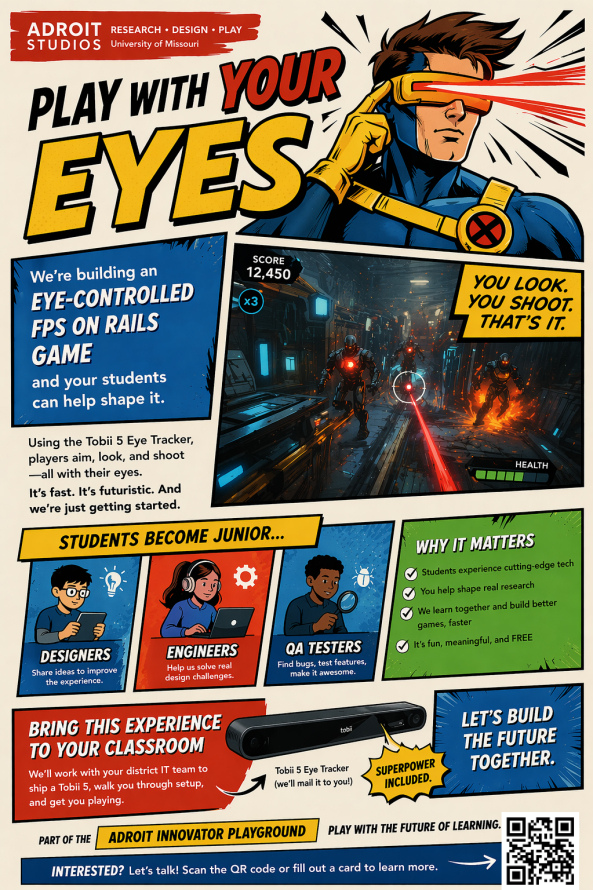
Download Poster

Solving for 3D

Eye tracking isn’t new. 

Major brands have been running it on Super Bowl commercials for years — if you’re spending that much money to put something in front of people, you want to know exactly what they’re looking at. Retailers do it on websites. It’s how they learn which colors stop your eye, which layouts make you click, which headlines you actually read.

But nobody could do it inside a game. 

The tools that work on flat screens fall apart the moment a player starts moving through a 3D world. Different angles, different distances, objects coming from every direction. So we built something that tracks exactly where a player’s eyes go inside the game itself — automatically, every session, every user.

The hardware is a small device called a Tobii 5 that clips onto a monitor and tracks exactly where your eyes land in real time. The game we built to test it is a first-person shooter you aim with your eyes — a clean environment that generates usable data without a hundred variables getting in the way.

It also turns out to be genuinely fun to play. Which, around here, is never an accident.

Bigger Than a Game

It started with a simple question: are players actually looking at what we think they’re looking at? That’s our Founding Director Joe Griffin’s PhD in a sentence — and the answer turned out to matter a lot more than anyone expected.

We’ve talked to vision doctors who see therapy applications — patients with eye disorders, turning painful clinical exercises into something a kid actually wants to do. We’re exploring it as an accessible controller for people who can’t use their hands. And we’re building the automated UX data stream that could change how the entire games industry evaluates whether their work is landing.

Favicon

Get involved

Contact Us to Get Involved
Play With Us